Ask five suppliers for the price of a "solar security camera" and you will get five numbers that differ by a factor of four. That is not because anyone is lying — it is because "solar security camera" describes products ranging from a single-lens WiFi unit for home doors to a four-lens 4G PTZ system with dual panels and external antennas. If you are buying at wholesale to resell or deploy, this guide gives you the reference framework: realistic FOB price bands by product class, the seven cost drivers behind every quote, how MOQs work, and the step-by-step OEM process from first inquiry to a loaded container.
1. Wholesale price bands by product class (2026)
The table below reflects typical factory-direct FOB China ranges for current-generation product, ordered in normal wholesale volume. Treat them as planning bands, not quotes — exact pricing depends on the seven factors in the next section.
| Product class | Typical configuration | Indicative FOB range (USD) |
|---|---|---|
| 1–2 lens, WiFi solar | Single/dual lens, 4–6W panel, app live view | $16 – $30 |
| 2 lens, 4G solar | Dual lens + 4G modem, siren/light deterrent | $25 – $45 |
| 3 lens, solar PTZ | Multi-lens simultaneous view, PIR + AI, strobe | $35 – $55 |
| 4 lens, 4G solar flagship | Dual panels, large LiFePO4 battery, 4G + WiFi | $50 – $80 |
| Specialty (AOV / street-light cam) | 24/7 recording or integrated lighting | $45 – $85 |
Two comparisons worth internalizing: a 4G modem and antennas add roughly $8–15 of BOM cost over the same WiFi model, and every extra lens adds a sensor, a lens barrel and processing — which is why the 3-lens to 4-lens step is the biggest jump. For the full lifecycle arithmetic (including what wired systems really cost), see our 5-year solar vs wired cost comparison.
2. The seven factors that move your quote
- Lens count and sensor grade. More lenses mean more sensors; "black-light" full-color sensors cost more than standard IR ones but lift night performance visibly.
- Connectivity. WiFi-only is cheapest; 4G adds modem, antennas and band-specific certification; dual-mode 4G/WiFi units sit at the top.
- Solar hardware. Monocrystalline vs polycrystalline, fixed vs detachable panel, single vs dual panel — the single biggest quality-vs-price lever on an off-grid camera.
- Battery. Capacity and chemistry. LiFePO4 costs more than lithium-ion but triples cycle life — decisive for a 365-day-unattended product.
- Order quantity. Volume tiers move unit price in steps, not smoothly; crossing a production-batch threshold can be worth 5–10%.
- OEM customization depth. Logo printing and custom packaging are minor cost items; custom colors, housing tooling or firmware feature work are separate projects.
- Incoterms and shipping. FOB and CIF prices differ by exactly what they include — always compare quotes on the same term.
3. MOQ: how minimums actually work
- Samples and pilots: 1–20 units at sample pricing, mixed models allowed. This is how every serious buyer should start.
- Spot wholesale: small production lots for standard models — the practical entry point for a first market test.
- OEM branding (logo + packaging): modest per-model minimums, because customization is applied in the packing stage.
- Full ODM (housing, firmware, custom UI): project-based minimums and tooling costs, quoted individually.
If a supplier quotes you one fixed MOQ for everything, they are a trading company reselling someone else's line — a factory controls its own thresholds. Our FAQ page covers MOQ, samples and payment terms in detail.
4. The OEM buying process, step by step
Here is the exact sequence we run with new OEM customers — and the sequence any good factory should follow:
- Inquiry with context. Send your target market, installation scenario, quantity and any reference model. "200 units of a 3-lens 4G solar camera for farm deployments in East Africa" gets a precise quote the same day; "best price please" gets a guess.
- Specification and band confirmation. The factory confirms the exact configuration — lens count, battery chemistry, panel type and the LTE bands for your carriers — in writing.
- Quotation on your chosen Incoterm. Unit price by quantity tier, packaging spec, lead time and validity period, all itemized.
- Sample order. Test units at sample pricing, shipped fast. Test them against a written protocol — cloudy-day autonomy, night footage, false alarms, local SIM, app handover.
- Order confirmation. Proforma invoice, 30% deposit by T/T (or agreed terms), branding artwork approved — logo file, packaging dieline, any firmware defaults.
- Production and QC. Typical production runs 15–25 days depending on quantity and season. Aging tests, waterproof checks and final inspection happen before packing; third-party inspection is welcome.
- Balance, shipment, documents. 70% balance before shipment; packing list, commercial invoice and B/L issued; container loads with per-model carton labeling for easy warehouse sorting.
- After-sales. Warranty terms confirmed (we run 12 months), spare-parts ratio agreed for container orders, firmware/app support for the product's life.
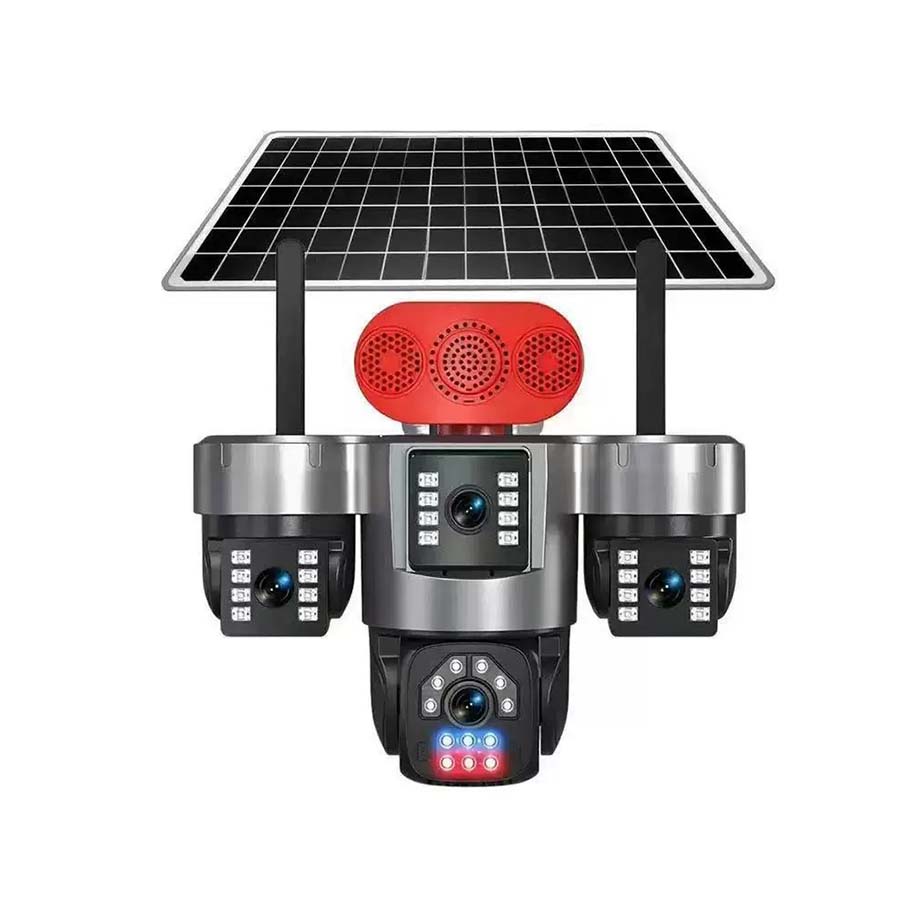
OEM favorite: MS33 3-Lens Solar Camera
Best-selling mid-tier model for OEM programs — 110dB siren deterrent, PIR + AI detection, and proven logistics-friendly packaging for container orders.
View MS33 Specs Start an OEM inquiry →5. A worked example: the landed math of a 300-unit order
Nothing makes price bands concrete like a worked example. Say a distributor plans 300 units of a 3-lens 4G solar model (MS31 class) for compound and farm customers:
- Factory FOB: roughly $36–45/unit at that volume — call it $13,000 for the order, with logo printing and branded cartons included at standard OEM minimums.
- Sea freight and insurance: on CIF terms typically 8–12% of goods value to East and Southern African ports, depending on season and space — about $1,100–1,600 to Maputo or Beira.
- Import duty and VAT: paid by you at destination, not wrapped into the factory quote. Budget your national rate on the CIF value — in most African markets that adds roughly 20–35%.
- Spares: a 1–2% spare ratio adds a handful of units — cheap insurance against DOA claims eroding your launch.
- Landed cost: roughly $57–65 per unit once freight and your own duty are counted. If your market retails the category at 2–2.5× landed cost, the model supports both a healthy margin and the demo-unit stock that closes deals.
The leverage points are visible in the arithmetic: quantity tier, Incoterm choice and customization depth move the landed cost far more than haggling over the last dollar of FOB price.
6. How to buy smarter: four habits of good buyers
- Quote like-for-like. Send every supplier the same one-page spec sheet; comparing a 6W monocrystalline unit against a 3W polycrystalline one by price alone is meaningless.
- Budget the data plan into the business case. At $3–8 per camera per month, connectivity is a real line item for your customers — PIR wake-up designs keep it defensible.
- Plan two tiers of stock. One proven best-seller you reorder monthly, one flagship for project bids. Deep SKU catalogs tie up cash; two well-chosen models build it.
- Get the warranty in writing. Twelve months, with a defined spare-parts ratio for bulk orders — this is what turns your resale into a reputation.
Frequently asked questions
What payment terms are standard for first orders?
Typically 30% T/T deposit, 70% balance before shipment. Established partners move to more flexible terms. Full details on our payment & OEM FAQ.
What is the usual lead time after the deposit?
15–25 days for production depending on quantity and model mix, plus shipping time — sea freight to most African, Asian and European ports runs roughly 25–45 days. Plan seasonal orders backwards from your sales window.
Can I get my own brand on the cameras and the app defaults?
Yes — logo on housing, custom packaging, and pre-configured firmware defaults (server region, app settings) are standard OEM scope. Full ODM with custom housing is quoted as a separate project.
Are the price ranges above retail prices?
No — they are factory-direct wholesale FOB bands for trade buyers. Retail margins, local taxes and last-mile delivery stack on top depending on your market.
The bottom line
Solar security camera pricing is not one number — it is a matrix of lens count, connectivity, solar hardware and battery chemistry, moved by quantity and customization. Anchor your sourcing in the spec, not the sticker: confirm bands and battery chemistry in writing, test samples before volume, and buy from a factory that itemizes its quotes. Then the numbers in this article become a floor you can beat with negotiation, not a trap you fall into with a cheap container.