Parking is the one surveillance application where lighting and monitoring are the same project. A car park that is dark is unsafe regardless of how many cameras are on it, and a car park that is lit but unwatched still produces the same dispute every week: whose car was it, and when did it happen? That convergence is why a street-light camera — illumination and surveillance in a single head on a single pole — is usually the most economical way to cover a parking area, and why this guide is organised around coverage geometry rather than camera features.
1. Why one pole beats two installations
A conventional car park project splits into two contracts: an electrician installs lighting poles with their circuits and foundations, then a security contractor installs cameras with their own power and network runs. A street-light camera collapses that into one line item:
- One pole, one foundation. The camera does not need its own mast, its own base or its own trench — it rides the lighting pole that was going in anyway.
- One power arrangement. Either the unit draws from the lighting circuit where the pole is already powered, or it is fully self-sufficient with its own panel and battery where the pole is not.
- No separate network. Connectivity is built in, so there is no data cable alongside a power cable along the same route.
- Light that helps the camera instead of hurting it. Correctly positioned, the luminaire raises the light level the sensor works in, which is the difference between colour footage of a person and a moving silhouette.
- One thing to maintain. A single head to service, a single set of credentials, and, on solar models, one battery and one panel rather than a separate circuit to fault-find.
On a fifty-space lot, the saving is not marginal: it is an entire foundation, an entire cable route and an entire second site visit.
2. Coverage geometry: the number that decides how many poles you need
Car park coverage is a geometry problem, and the two mistakes are opposite: assuming one high camera sees everything, and buying a camera for every two bays. Three ranges matter, and they are not the same number:
| Range | What it means | What it is good for |
|---|---|---|
| Detection range | You can see that something is happening | Alerting, and knowing a vehicle or person entered the frame |
| Recognition range | You can tell a person from a shape and see what they are doing | Confirming that an incident is real before responding |
| Identification range | You can distinguish a face, clothing detail or vehicle colour | Evidence that stands up in an insurance claim or a police report |
Be sceptical of any specification that quotes one range figure. A supplier who can tell you the identification distance at night, in colour, has tested it — and that is the number that matters in a car park, because the reason you have cameras there is to answer "who was it?".
3. Which camera type for which part of the lot
| Position | Job to be done | Suggested configuration |
|---|---|---|
| Entrance and exit lanes | Every vehicle that enters, at a known angle and speed | Fixed 2–3 lens unit — MS32 class — or a street-light head with the approach in view |
| Open rows and manoeuvring area | Wide area awareness, patrolling coverage | PTZ with 360° coverage — MS41 / MS45 class |
| Perimeter and boundary lighting | Illumination plus surveillance along the outer edge | Street-light camera — MSL31 class |
| Pedestrian route, stairs and lift lobby | Individual identification at close range | 2-lens unit at lower height — MS22 class |
The entrance and exit deserve a dedicated fixed view rather than a share of a rotating camera. Those lanes are the highest-value frames in the entire installation, and a PTZ that happens to be looking elsewhere at the moment a car passes is worth nothing at all.
4. What car park crime actually looks like
- Vehicle break-in and theft. Concentrated at night and at the outer edges of the lot, away from the lit building frontage — which is exactly where lighting and coverage are weakest.
- Wheel and catalytic converter theft. Fast, and typically carried out by a vehicle that parks alongside. This is where recording the visiting vehicle matters more than recording the victim's.
- Charging cable and infrastructure theft. EV charge points and their cables are recurring targets, as are meters and distribution cabinets.
- Damage disputes. Door dents, scraped bumpers, damaged trolley bays. These are the most frequent claims and the least dramatic, and they are resolved entirely by timestamped footage rather than by detection.
- Loitering and antisocial behaviour. Which drives genuine complaints, empties a lot after dark and is best addressed by combination of light and visible cameras.
5. Night performance: where cheap systems fail
- Insist on colour at night. Infrared monochrome tells you a vehicle was there; it will not tell you the colour of the car or the jacket of the person. In a car park, colour is the evidence.
- Avoid pointing into the luminaire. Backlight from your own pole washes out the whole frame. Mount the camera below and offset from the light head, never in its beam.
- Watch for headlight flare. Approach lanes need the sun and headlight direction considered at design stage — a camera facing the entry glare records nothing but a white rectangle as cars arrive.
- Control the shadow pattern. A single high luminaire creates deep shadow between vehicles. Two or more poles with overlapping light, with cameras offset on each, gives usable coverage of the gaps between cars.
- Check the winter and rainy-season reality. Wet tarmac reflects light and blows out highlights; dust in a dry season diffuses it. Angle and mounting height have more effect on image quality than any processing feature.
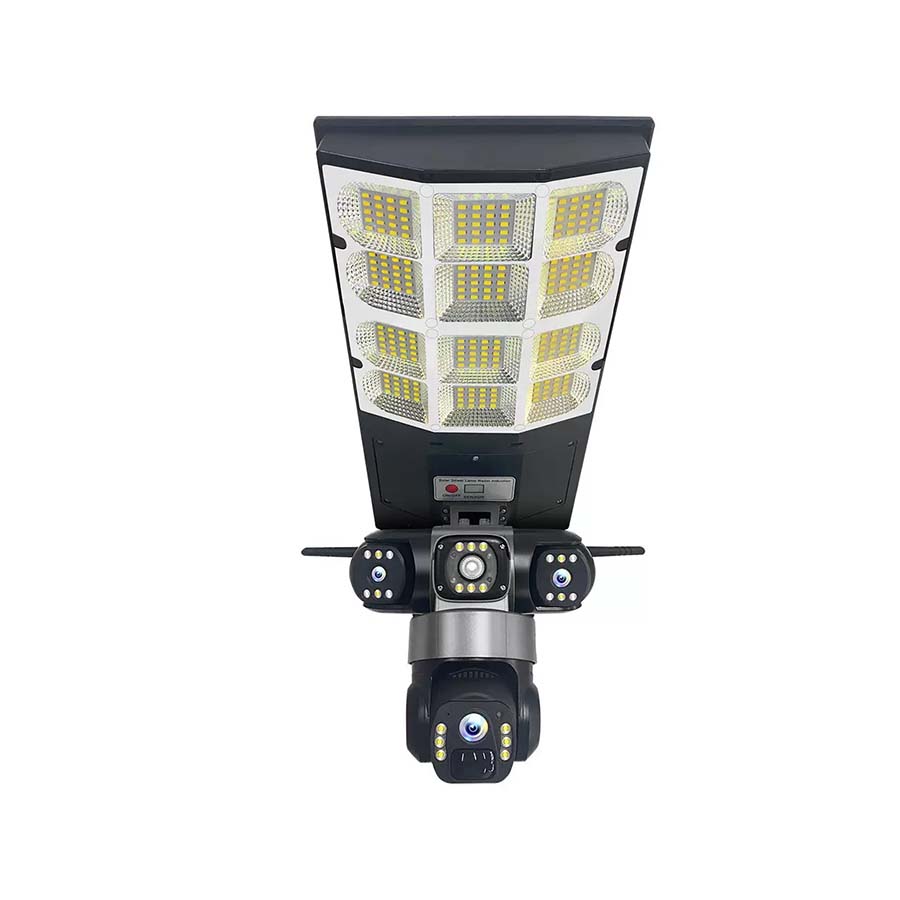
One pole, two jobs: MSL31 Solar Street-Light Camera
Integrated high-output luminaire and 360° camera head, self-powered by its own panel and battery — illumination and surveillance from a single foundation, with no separate lighting circuit.
View MSL31 Specs Size a lot layout →6. Sites with no power at all
The self-powered versions of these units extend parking coverage into places where a lighting circuit is not available or not worth building:
- Mine, quarry and construction site parking. Temporary lots that move with the project, where no permanent supply exists and the vehicles and plant parked overnight are high-value targets.
- Highway service areas and remote rest stops. Long stretches of parking where extending the grid to each pole is prohibitive.
- Event, stadium and seasonal parking. Overflow fields in use for a few weeks a year, where a permanent installation makes no financial sense.
- Rural and off-grid commercial premises. Warehouses, depots and farm yards where the lot is a distance from the building supply — see our off-grid guide for the sizing logic.
In all four cases the unit is deployed the day it arrives, with no trenching, no supply upgrade and no dependence on a lighting contract being completed first.
7. Deployment and operating notes
- Pole height 6–8 m for area coverage, with a downward tilt that keeps the horizon out of frame. Height buys coverage area; tilt buys usable detail within it.
- Solar pole orientation follows the equator as always — north-facing in the southern hemisphere, south-facing in the northern — and must clear the shadow line of buildings and trees through the whole day, not only at noon.
- Alerts that people will act on. PIR with human-shape filtering is what keeps a car park alert stream trustworthy — without it, every cat crossing the tarmac becomes a notification, and after a week the alerts are muted and the system is decorative.
- Multi-user access for the facilities manager, the security contractor and the client, without sharing credentials.
- Local TF card recording so a network outage never leaves a claim without footage.
The bottom line
Cover a car park by asking what has to be identified, from which pole, and at what range at night — then let illumination and surveillance share the same pole. Done that way, one installation does the work of two, the lit areas and the covered areas coincide instead of contradicting each other, and the footage is good enough to answer the only question that ever gets asked: which vehicle was it, and when did it happen?
Frequently asked questions
Can one camera cover an entire parking lot?
Only a small one. Detection range is much longer than identification range, so a single high camera may see the whole lot while being unable to identify a face or a vehicle at its far edge. Practical layouts use a small number of poles — typically one per twenty to thirty spaces for the areas that matter — with the entrance and exit covered by a dedicated fixed view.
Do parking lot cameras need their own lighting?
Not if you choose a street-light camera, which integrates the luminaire and the camera head on one pole. This is usually the most economical arrangement in a parking area, because the pole, foundation, and in many cases the power supply are already being installed for lighting. The camera also benefits from the higher light level rather than fighting it.
Can a solar camera work in a parking lot without any power supply?
Yes. Self-powered street-light cameras carry their own panel and battery, which makes them suitable for mine and construction site parking, remote service areas, seasonal event parking and rural depots where extending a lighting circuit is not practical. The lot is covered the day the units arrive, with no trenching and no supply upgrade.
How far can a parking lot camera identify a number plate or a face?
It depends on more than the resolution figure on the box — lens angle, mounting height, tilt, light level and the angle of approach all matter. As a working guide: detection is measured in tens of metres, recognition at roughly half that, and reliable identification of a face or plate in colour at night at a fraction again. Ask any supplier to state the identification distance at night rather than the detection range.
Will a camera system stop vehicle crime in a car park?
The combination of light and a clearly visible camera changes behaviour more than any recorded footage does, so yes, in practice it reduces incidents. What cameras reliably deliver is resolution of disputes — damage claims, theft reports and insurance questions — which is often the larger ongoing cost for the operator.