Walk into any distributor meeting and the conversation starts with unit price: a wired 4MP dome costs $40, a solar 4-lens PTZ costs $120, therefore wired is "cheaper." Over a five-year deployment, that comparison is upside down. The sticker price of a camera is perhaps a third of what the system really costs — and the hidden two-thirds punishes wiring hardest. Let's run the actual numbers.
What you actually pay for a wired system
The camera itself is the cheapest line item. Everything around it costs more:
- Trenching & cabling: outdoor-grade Cat6 + conduit + labor typically runs $2–8 per meter depending on surface. A 300-meter perimeter loop: $1,000–2,400 before a single camera is mounted.
- Power infrastructure: either PoE injectors and a powered switch, or electricians pulling 220V to each camera cluster. More trenching, more conduit.
- Electricity: modest per camera (3–8W), but a 16-camera site still draws continuously, 24/7/365 — and in many African and South Asian markets, that means running through an unreliable grid or paying for a generator's overhead share.
- NVR & storage: a wired analog/IP kit needs a recorder, hard drives, and a ventilated cabinet — plus replacement drives at year 3–4.
- Maintenance call-outs: rodents chew cable, conduits flood, connectors corrode. Every fault means a truck roll, a ladder and a technician's day.
What you actually pay for a solar system
A solar 4G camera is a one-box deployment: panel, battery, camera, modem. The cost structure looks like this:
- Higher unit price: a quality multi-lens solar PTZ costs 2–4× a wired dome — this is the honest part of the comparison.
- Zero cabling cost: two screws and a pole. Installation is minutes per unit, not days per site.
- Zero electricity: the sun is free, even where the grid isn't.
- SIM data: typically $3–8/month per camera for motion-triggered usage — the solar system's only recurring cost.
- Battery replacement: the one real line item — LiFePO4 packs at year 4–5 (inexpensive lithium packs at year 2, which is exactly why we insist on LiFePO4).
Worked example: 8-camera compound, 5 years
Typical scenario: a farm or logistics yard with an 8-camera perimeter, 300m of total runs, mid-tier labor costs (US pricing; emerging-market labor narrows the gap further in solar's favor):
| Cost item | Wired 8-camera system | Solar 4G system (8× multi-lens PTZ) |
|---|---|---|
| Cameras | 8 × $40 = $320 | 8 × $110 = $880 |
| NVR + drives | $450 | $0 (TF card + cloud) |
| Trenching + conduit + cable | $1,600 | $0 |
| Power infrastructure & labor | $900 | $200 (pole mounts, 2 hrs/unit) |
| Electricity, 5 years | $350 | $0 |
| SIM data, 5 years | $0 | 8 × $5 × 60 mo = $2,400 |
| Maintenance call-outs, 5 years | $800 | $150 (battery checks, cleaning) |
| Battery replacement | Drive replacement $200 | $240 (8 × $30 LiFePO4, year 4) |
| 5-year total | ≈ $4,620 | ≈ $3,870 |
Where the data-plan cost flips the math
The SIM plan is the solar system's weak point — and it is manageable. Cameras with PIR wake-up (sleep at ~0.5W, record on event) use 2–6GB/month. Always-recording designs can burn 30GB+. Over five years, that design choice alone is a $1,500+ difference on 8 cameras — which is why we steer farm and perimeter buyers to PIR-first models like the MS21 and MS31.
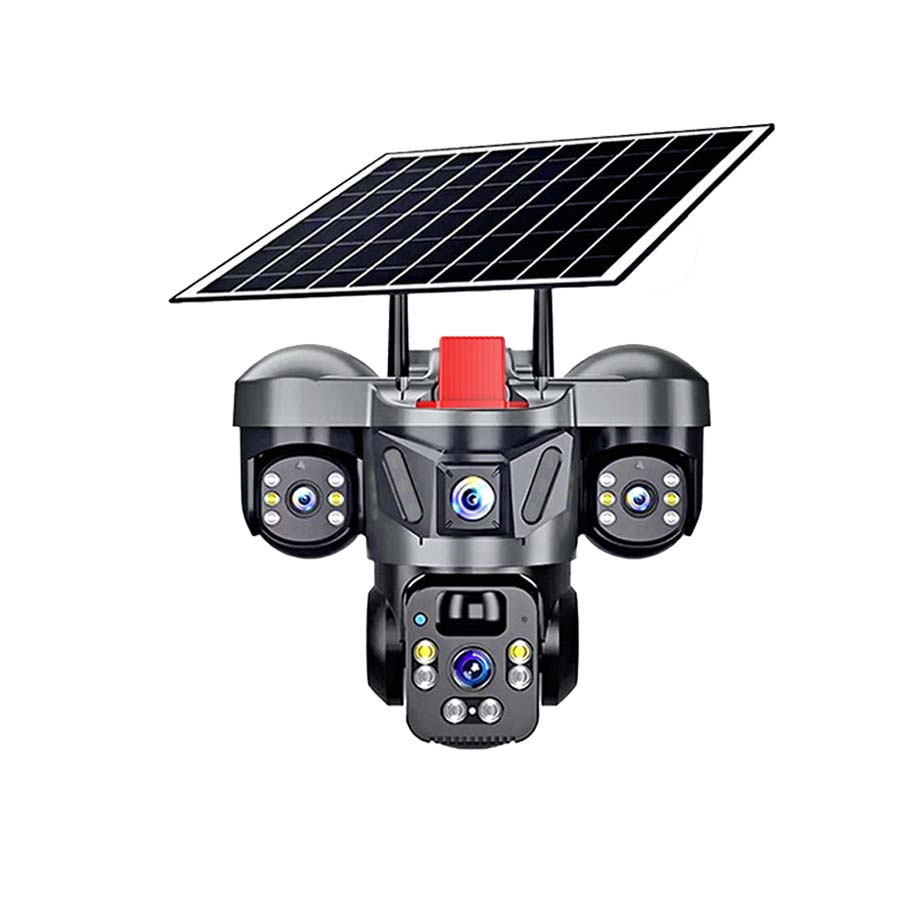
Recommended: MS31 Solar 3-Lens + Strobe
Triple-lens simultaneous coverage, PIR wake-up for low data drain, red strobe deterrence — the value pick for perimeter projects that used to be wired.
View MS31 Specs Ask about wholesale pricing →When wired still makes sense
Solar is not a religion. Wired wins when: power and conduit already exist (retrofit into old infrastructure), cameras run 24/7 continuous recording at high bitrate (control rooms, casinos), or the site is indoors with cheap power everywhere. Our own outdoor wired line exists for exactly these jobs.
Frequently asked questions
Is the upfront cost of solar ever lower than wired?
Yes — whenever the site has no existing conduit and the run exceeds ~100m. Trenching alone often exceeds the entire solar system cost, which is why solar dominates new farm, construction and rural deployments.
What happens to the footage if the SIM data runs out?
Footage keeps recording to the onboard TF card (up to 128GB) — only remote live-view and push alerts pause. Nothing is lost locally.
How long do the batteries actually last?
LiFePO4 chemistry is rated for 2000+ cycles — 4–5 years of daily solar cycling. Cheaper Li-ion packs degrade in 1.5–2 years, which shows up as a "camera dies every winter" support pattern.
Can I mix wired and solar cameras in one app?
Yes — our models run on the same platform apps, so a yard can combine mains-powered outdoor units and solar 4G units in one interface.
The bottom line
Compare five-year totals, not price tags. For any site that needs new cabling, has unreliable grid power, or sits more than a cable-pull away from the nearest outlet, solar 4G delivers a lower true cost — with blackout-proof operation included for free.