Farm security is where standard camera advice falls apart. The recommendations written for a shop or an office assume three things you do not have: mains power at the mounting point, a WiFi network to join, and a perimeter you can cover from one corner. A farm has none of them. What it does have is distance, darkness, and theft that concentrates on a handful of high-value points — fuel, feed, tools, pumps and livestock. This guide is the selection logic we use with agricultural buyers and installers, from a single gate to a multi-site estate.
1. The four constraints that decide everything
Before comparing models, fix these four variables — they eliminate most of the catalogue immediately:
- No mains power at the pole. Run cable 400 metres across a field and you have paid more for trenching than for the camera. Solar is not a compromise here, it is the only sensible option.
- No WiFi on the property. Farm coverage area is measured in hectares, not rooms. The camera must carry its own 4G connection, and that connection must match the bands your local carriers actually use.
- Nothing to hide behind. An open field has no walls, no street lighting and no passing traffic. The camera is the only witness — so footage quality at 20–40 m matters more than in any urban installation.
- Nobody visits it. A camera 20 km from the farmhouse cannot need a monthly battery swap. Autonomy over cloudy weeks is the specification that keeps the system alive.
2. Match lens count to the layout you actually have
The most common overspend on a farm is buying four lenses where two do the job — followed closely by buying two and retrofitting a second camera at every site. The right question is not "how many lenses?" but "how many things must be watched at the same time?" Each lens on a multi-lens unit has its own sensor, so a three-lens camera watches three areas simultaneously, with no PTZ rotation delay and no blind window while the motor swings.
| Farm type | What must be covered at once | Suggested configuration |
|---|---|---|
| Smallholding, single gate | Gate and one yard | 2-lens unit — MS21 class |
| Dairy, poultry, piggery | Gate, yard and feed store simultaneously | 3-lens unit — MS31 / MS32 class |
| Large compound, equipment yard | Several buildings and a long perimeter | 4-lens dual-panel unit — MS41 / MS45 class |
| Tracks, far fences, no infrastructure | Illumination and surveillance from one pole | Street-light camera — MSL31 class |
Where a trespasser moves between buildings in seconds, that simultaneity is the difference between usable evidence and an empty frame. It is also why we rarely recommend a single-lens PTZ as the primary camera on a farm: by the time it turns, the vehicle has gone.
3. Power sizing: design for the cloudy week, not the sunny day
Panel wattage is the number buyers compare and the number that matters least. What matters is how many consecutive overcast days the system survives, which is a function of panel wattage, battery capacity and how much energy the camera consumes at night.
- Battery chemistry. LiFePO4 packs (2,000+ cycles) outlast generic lithium-ion (500–800 cycles) by a wide margin in daily charge-discharge service. On a fleet of 200 cameras, this single difference can outweigh the entire unit-price gap between two quotes.
- Panel type. Monocrystalline harvests 20–30% more than polycrystalline in the same footprint and is noticeably better in diffuse light. Under a tropical dry season the difference is invisible; in a rainy season it is the difference between online and offline.
- Shade handling. If more than a third of your mounting points sit under a barn eave, a large tree or on a shaded wall, choose a model with a detachable panel such as the MS22 — the panel goes in the sun, the camera stays where the coverage is.
- Consumption discipline. PIR wake-up recording is the single biggest autonomy lever. A camera that records continuously drains in days what a PIR-triggered camera draws in weeks.
4. Connectivity: the 4G band question that decides whether it works at all
"Universal 4G" is a marketing phrase, not a specification. A modem without your market's LTE bands in writing will fall back to 2G, drop offline at the edge of coverage, or work in the city and fail on the farm — which is exactly where you need it. Three things to settle before ordering:
- Band list per market. Confirm the exact LTE bands used by the carriers your customer relies on, and get the modem's supported band list in writing. We do this as standard on every order — see the band discussion in our Nigeria 4G guide.
- Signal level at the mounting point. Take dBm readings on site. Anything weaker than about −105 dBm pushes you toward external-antenna models such as the MS45; an internal antenna will hold a connection that looks fine in the app and drops the moment you need the recording.
- Data consumption. PIR-triggered cameras with live view on demand typically consume 2–6 GB per month per unit. Continuous-streaming designs can multiply that, and the SIM bill lands on your customer every month — a hidden cost that erodes the relationship long after the sale.
5. Mounting practice on a working farm
- Height 3–4 m. High enough to be out of casual reach, low enough to identify a face rather than a hat.
- Panel orientation by hemisphere. Face the panel toward the equator — north in the southern hemisphere, south in the northern — and keep it clear of the shadow line of trees and roof edges through the day.
- No branch within two metres. Moving foliage is the number one cause of false alerts and of drained batteries on solar units.
- Angle the lens down, not across. A camera aimed at the horizon catches sky, which at night is worth nothing. Ten to fifteen degrees of downward tilt roughly doubles usable detection range.
- Earthing and surge protection on exposed poles in high-lightning regions — one strike takes out the modem, not the lens.
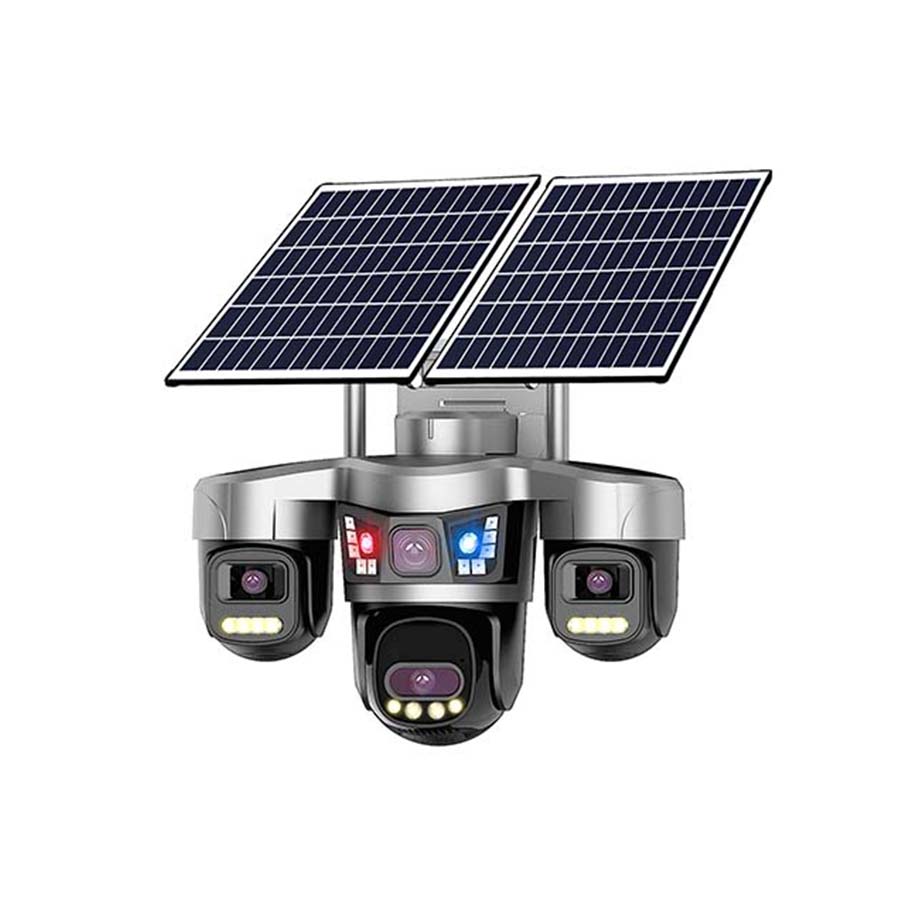
Farm workhorse: MS41 4-Lens Solar Camera, Dual Panels
Four simultaneous lenses, dual monocrystalline panels and a large LiFePO4 battery — the configuration most of our agricultural installers standardise on for large compounds and equipment yards.
View MS41 Specs Request a sample kit →6. Deterrence that still works when nobody is watching
Detection without deterrence just produces a recording of a theft in progress. On a farm, where the nearest response is often half an hour away, the camera has to do the responding itself:
- 110 dB siren and strobe. Loud enough to end an attempt at a fuel tank, and visible from a distance at night. The intent is to interrupt, not to punish.
- Two-way audio. Speaking through the camera converts a passive box into a person telling the intruder they have been seen.
- PIR plus human-shape filtering. Pixel-only motion detection means every branch, goat and passing dog becomes a 3 a.m. notification — and a drained battery. PIR with AI human-shape filtering keeps nuisance alerts near zero, which is what makes the alerts trustworthy.
- Spotlight and full-colour night vision. Colour footage of clothing and vehicle paint is what turns a report into an identification.
7. Scaling from one gate to a whole estate
Once one camera proves itself, farms extend — and the extension should be planned, not improvised. Three practical patterns from installed fleets:
- Mix the specs deliberately. 2-lens units for outer paddocks and gates, 4-lens dual-panel units for the central compound, street-light cameras for tracks and far fences that need illumination as well.
- One app for everything. All models run on the same app, so a mixed fleet still means one place to check, one place to manage alerts and one place to share access with a farm manager.
- Recording redundancy. Each unit records to a local TF card and streams live to the phone, so a cellular dropout does not mean lost evidence. No equipment shed, no recorder, no separate power feed.
If you are buying for resale or installing across multiple farms, our farm procurement playbook covers fleet sizing, sample-testing protocols and the specification red flags that separate a camera built for this environment from one that merely survived a demo.
The bottom line
A farm camera is judged by two numbers, and neither of them is price. It is whether the system still records on the fifth cloudy day, and whether its 4G radio holds the signal at the exact pole where you mounted it. Get those right and the rest — lens count, siren, app — is configuration. Get them wrong and you have bought a very well-packaged lesson in specification writing.
Frequently asked questions
Do farm security cameras really work without electricity?
Yes. A solar camera carries its own panel and battery, so no mains connection is needed at the mounting point. The practical limit is how many consecutive overcast days the system can run, which depends on panel wattage, battery chemistry and whether recording is PIR-triggered rather than continuous. For rainy-season regions we recommend sizing for at least five days of no sun.
How many solar cameras does one farm need?
Most smallholdings settle on one to two units, dairy and poultry operations on three to six, and large mixed compounds on six to twelve. Start where theft concentrates — fuel storage, feed store, gates and livestock pens — and add coverage from there rather than attempting a complete perimeter at once.
What happens during the rainy season when the panel gets almost no sun?
The battery carries the system. With a LiFePO4 pack and PIR-triggered recording, a properly sized unit typically runs five to seven days with no meaningful sunlight, and longer in low-power standby mode. Continuous recording is what kills autonomy, which is why we do not recommend it for off-grid farm installations.
Can I monitor farm cameras from another country?
Yes. All models stream over 4G or WiFi to the iCSee app on iOS and Android, so a farm in Nigeria can be watched from Shenzhen, Dubai or London with the same live view, playback and alert features. Multi-user sharing lets you give the farm manager access without handing over the account.
Do the cameras need a recorder or NVR building?
No. Each camera records to a local TF card and streams live to the phone app. There is no recorder, no separate power feed and no equipment shed to protect — which also removes a common theft target on remote sites.