Most articles about farm security cameras tell you how to pick one unit for one gate. This one is written for a different reader: the distributor, installer or agribusiness buyer who is ordering 50, 200 or 500 units to cover farms, ranches and off-grid sites across a whole region. At that scale, the questions change completely. You are no longer asking "which camera is best?" — you are asking "which specification survives my climate, my customers' SIM networks and my service team?" and "what does each camera actually cost me over five years?" Here is the playbook we walk through with every agricultural distributor before their first container order.
1. Start with site survey data, not with a catalog
Volume buyers lose money in one of two ways: ordering a specification that under-delivers (and drowning in warranty returns), or over-speccing every unit (and losing bids to cheaper competitors). Both mistakes come from skipping the site survey. Before locking a specification, collect from your pilot sites:
- Sun exposure per mounting point. A camera under a barn eave needs a detachable external panel; an open-pole install does not. If more than a third of your mounting points are shaded, prioritize models like the MS22 with a detachable panel.
- Cellular signal readings. Record dBm readings at each gate, barn and yard. Anything weaker than −105 dBm pushes you toward external-antenna models such as the MS45.
- What actually gets stolen. Fuel and diesel pumps need a lens on the tank; livestock need wide coverage on pens; tools need gate-plus-shed coverage. The theft pattern determines lens count, not the other way around.
2. Match lens count to coverage — and price the gap honestly
The fastest way to overspend on a farm fleet is to buy four lenses where two do the job, or to buy two lenses and then retrofit a second camera at every site. Do the coverage math per site type first:
| Site type | Typical coverage need | Recommended configuration |
|---|---|---|
| Smallholding / single gate | Gate + one yard | 2-lens unit — MS21 class |
| Dairy / poultry farm | Gate + yard + feed store, simultaneous | 3-lens unit — MS31 / MS32 class |
| Large compound / equipment yard | Multiple buildings, long perimeter | 4-lens dual-panel unit — MS41 / MS45 class |
| Remote tracks & no-infrastructure posts | Lighting + surveillance in one | Street-light camera — MSL31 class |
Because each lens on a multi-lens unit has its own sensor, a 3-lens camera watches the gate, the yard and the feed store at the same time — no PTZ patrol delay. On a farm where an intruder moves between buildings in seconds, that simultaneity is the difference between evidence and a shadow.
3. Run a 14-day sample test before committing to volume
Every professional buyer should test samples for at least two weeks across the worst conditions the fleet will face — not the best. We ship evaluation kits to agricultural distributors with a fixed test protocol:
- Cloudy-week autonomy test: cover the panel (or wait for real weather) and log how many days the camera runs on battery alone. Accept nothing below the supplier's stated figure.
- Night recording test: check full-color night footage at 15m, 25m and 40m from the mounting point, both with the unit's own IR and under farm floodlights.
- PIR false-alarm test: count push notifications over 48 hours with livestock moving nearby. Proper PIR + AI human-shape filtering should keep nuisance alerts near zero.
- SIM network test: run every sample on the same local carrier plan your customers will use — not on the plan that happens to be in your pocket.
- App handover test: have a non-technical employee set the camera up with the iCSee app alone. If they need your help, your customers will need it too — and they will call you.
4. Calculate the five-year cost per camera, not the sticker price
Farm deployments are judged over years, so your procurement decision should be too. A useful model for comparing two quotes:
- Hardware cost — camera, mounting, (usually included) panel and battery.
- Connectivity — SIM data plan per month; PIR wake-up designs keep this at roughly $3–8/month per camera, always-on streaming designs can triple it.
- Service cost — every site visit to swap a battery, re-seat a connector or reboot a modem costs a technician half a day on a farm. Cheap units generate visits; good units do not.
- Failure replacement — a unit that dies in month 14 costs you the replacement, the labor and an angry customer.
On a 200-camera fleet, the difference between a camera with a LiFePO4 battery (2000+ cycles) and a generic lithium-ion pack (500–800 cycles) alone can exceed the entire unit-price saving of the cheaper quote. We break this arithmetic down in detail in our solar vs wired 5-year cost comparison.
5. Watch for the five specification red flags
- Polycrystalline panels on an outdoor solar camera — 20–30% less harvest than monocrystalline, and it shows up in December, not in the demo.
- No stated cloudy-day autonomy. If the datasheet says "10000mAh battery" but never says how many overcast days that buys, the vendor has not tested it.
- Pixel-only motion detection. Without PIR, every swaying branch becomes a 3 a.m. alert and a drained battery.
- "Universal 4G" claims. A modem without your market's LTE bands in writing will silently fall back to 2G or drop offline. Confirm bands per market — we do this as standard on every order.
- IP54 or unspecified waterproofing. Farms mean dust storms and pressure-washing; IP66 is the floor.
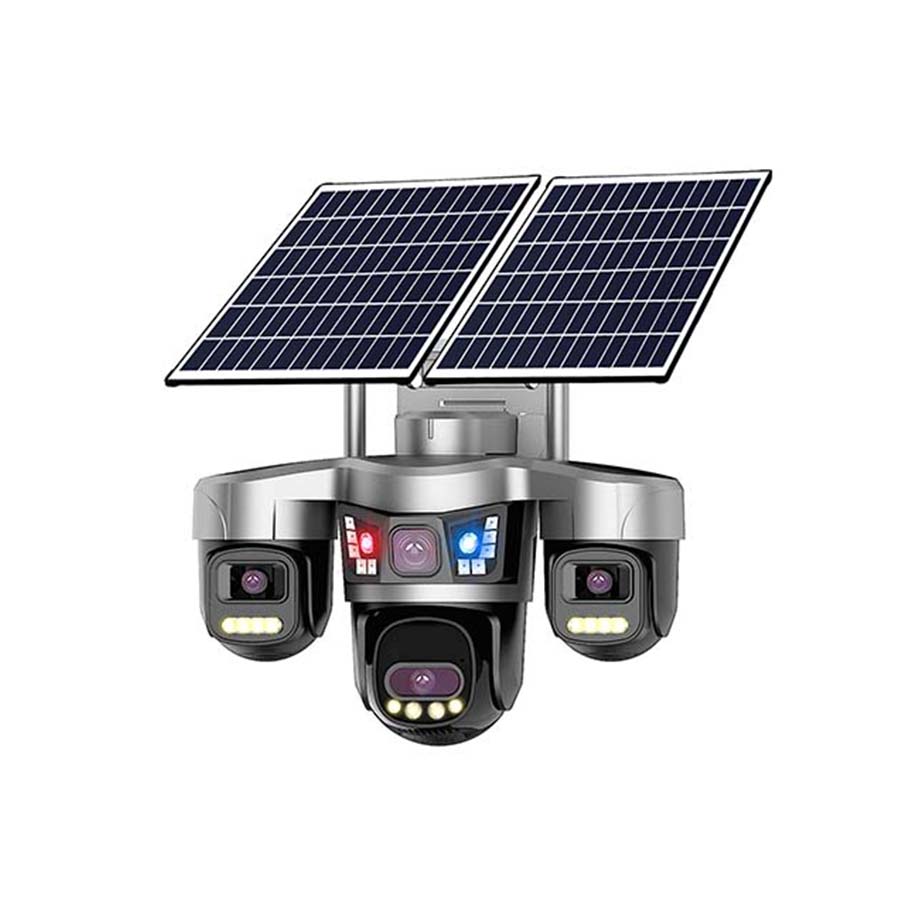
Fleet workhorse: MS41 4-Lens Solar Camera, Dual Panels
Four simultaneous lenses, dual monocrystalline panels and a large LiFePO4 battery — the configuration most of our agricultural distributors standardize on for large compounds.
View MS41 Specs Request a sample kit →6. Buy from a factory, not a trading screen
At volume, the factory behind the product matters more than the product sheet. Things to verify with any supplier before wiring a deposit:
- OEM/ODM depth. Can they print your logo, customize packaging, pre-set app defaults and region-correct 4G bands before shipment? This is standard for us — see our OEM/ODM FAQ.
- Certifications. CE, FCC, RoHS and ISO 9001 as a baseline; ask for the actual certificates, not the badge on the listing.
- Spare-parts policy. A 1–2% spare-unit ratio included with container orders saves months of back-and-forth on the occasional DOA.
- Firmware longevity. Ask how long app support and firmware updates continue after purchase. An orphaned app turns every installed unit into e-waste.
7. Sequence your roll-out like a professional
The fleets that succeed follow the same rhythm: 10–20 unit pilot across your most demanding sites → 14-day test protocol → spec lock (lens mix, band config, mounting kit) → first bulk order with spares → staged roll-out with installation training for your local crews. Skipping to the container order to "save a month" reliably costs three in warranty labor. Most of our distributor partners also keep one unit of each model in the office as a live demo — it closes farm-owner deals faster than any brochure.
Frequently asked questions
What is the typical MOQ for a farm-project order?
Sample and pilot orders can start at just a few units. For OEM branding (logo, packaging, firmware defaults) minimums are modest and scale by model — send your quantity for an exact answer.
Can different models be mixed in one container?
Yes — mixed-model containers are the norm for agricultural projects: for example 2-lens units for paddocks and 4-lens dual-panel units for headquarters compounds in the same shipment.
How many cameras does one farm actually need?
Most smallholdings settle on 1–2, dairy and poultry operations on 3–6, and large mixed compounds on 6–12. Start where theft concentrates: fuel storage, gates and livestock pens.
Do the cameras need an NVR or on-site recorder?
No. Each unit records to local TF card and streams live to the phone app over 4G/WiFi — there is no equipment shed to build. For customers who want cloud backup, optional cloud plans are available in the app.
The bottom line
Buying solar CCTV for farms in bulk is a systems decision, not a shopping decision. Survey the sites, test samples against a written protocol, cost each camera over five years — and buy from a factory that will put its autonomy numbers, band lists and warranty terms in writing. Do that, and your fleet runs for years with one SIM card per camera and zero site visits for electricity.