Some sites will never have a power line and will never have WiFi. A hillside cabin, a water pumping station, a telecom tower, a mining outpost, a fish farm on an island, a pipeline valve station — the list is long, and for every one of them the surveillance requirement is the same: see what happens, keep the evidence, and do it without connecting anything to anything. Off-grid security is a self-sufficiency problem before it is a camera problem, and this guide covers the three systems that have to be sized correctly: energy, connectivity and recording.
1. Energy: the system has to survive the worst week, not the average one
Every off-grid installation is sized around one question: how many consecutive days with no useful sunlight can this keep running? Three components answer it:
- Panel wattage. Sized for daily consumption plus the recharge margin needed to refill the battery after a cloudy stretch. Monocrystalline panels harvest 20–30% more than polycrystalline in the same footprint and perform noticeably better in diffuse, overcast light.
- Battery capacity and chemistry. LiFePO4 packs deliver 2,000+ charge cycles where generic lithium-ion manages 500–800. In a daily charge-discharge regime, that is the difference between a system that is still healthy in year five and one that needs its batteries replaced in year two.
- Consumption. The largest lever, and the one buyers ignore. PIR wake-up recording draws a fraction of continuous recording. A camera that records 24/7 without a grid connection must carry a much larger panel and battery to do it.
2. Recording mode: PIR wake-up versus always-on
This is the single decision that determines whether an off-grid installation is practical, and it is worth understanding the trade-off rather than picking on price:
| Mode | How it works | Best for |
|---|---|---|
| PIR wake-up recording | Camera sleeps at very low draw, wakes on movement, records the event and pushes an alert | Most off-grid sites — maximum autonomy, lowest data use, alerts on what matters |
| AOV always-on recording | Continuous low-frame-rate capture with no wake-up gap | High-value assets where any gap in coverage is unacceptable — models such as the MS44 |
PIR wake-up is the right default for the majority of remote sites: it conserves battery, cuts cellular data consumption to a few gigabytes a month and delivers an alert when something actually happens, rather than a timeline nobody will review. Always-on capture exists for the cases where a two-second wake-up interval is itself a security gap — and it should carry the larger panel and battery that mode requires.
3. Connectivity: 4G, bands and the weak-signal problem
Off-grid sites are, by definition, at the edge of network coverage. Three things separate an installation that stays online from one that frustrates its owner:
- Band matching in writing. "Universal 4G" is a marketing claim. Confirm the LTE bands of the carriers covering the site and the modem's supported band list, documented per order. We do this as standard, and it is the reason units keep working after they leave the city.
- External antennas for weak signal. Measure the signal at the actual mounting height. Below roughly −105 dBm, choose a model with external antennas such as the MS45. An internal antenna will happily hold a connection in testing and drop it under load.
- Data consumption. PIR-triggered units with on-demand live view typically consume 2–6 GB per month. Continuous-streaming designs can multiply that several times over, and on a remote site with a metered or throttled plan that is the practical cost of the "always on" choice.
4. What off-grid sites most often need to watch
- Fuel and generator compounds. Mobile, resellable and the highest-value overnight target at almost any remote site.
- Pumping stations and valve control points. Not for theft alone — visibility of unauthorised access and of equipment condition.
- Telecom towers and masts. Battery banks and copper are recurring targets; a camera on the compound gate answers most questions.
- Cabins, lodges and seasonal property. Empty for months at a time, which is precisely when most losses occur.
- Tracks, driveways and approach roads. One camera on the only approach tells you every vehicle that visited, which is often more useful than coverage of the building itself.
For remote tracks and far fences where illumination is also needed, a street-light camera such as the MSL31 combines the lighting and the surveillance in one pole — one installation instead of two, and no separate lighting circuit to power.
5. Mounting and maintenance on a site you rarely visit
- Assume every visit costs a day. Choose configurations that do not require periodic battery changes, SIM swaps or reboots.
- 3–4 m mounting height, out of casual reach, tilted down 10–15 degrees. Coverage of the horizon at night is wasted footage.
- Panel orientation toward the equator, clear of the shadow line of trees and structures through the full day, not just at noon.
- Earthing and surge protection — remote poles in high-lightning regions lose modems, not lenses.
- Local TF card recording so a cellular outage does not create an evidence gap. The card records regardless of the network.
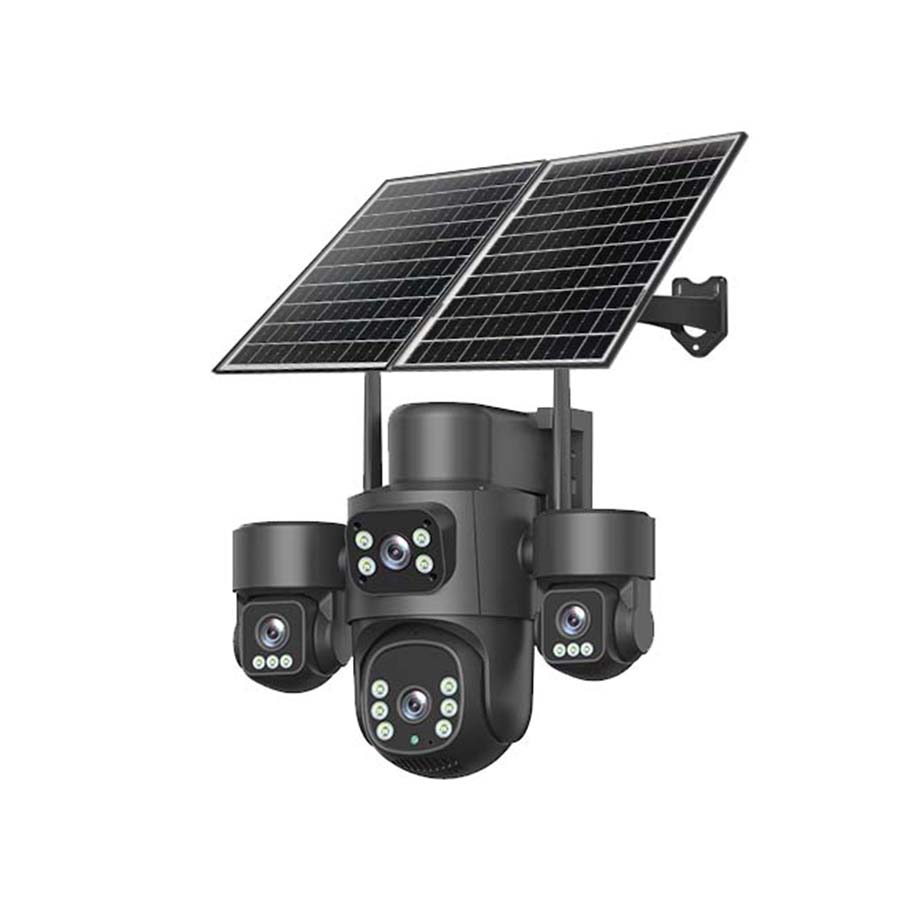
Weak-signal sites: MS45 4-Lens Solar PTZ with External 4G Antennas
External antennas hold the cellular link where internal ones drop it, with four simultaneous lenses and dual panels for full compound coverage from one pole.
View MS45 Specs Discuss your site →6. Remote management: checking on a site you cannot drive to
The operational test of an off-grid system is not how it performs on the day of installation, but whether it can be managed without visiting. What to verify before buying:
- Live view and playback over 4G from any location, so a fault can be diagnosed before anyone travels to the site.
- Push alerts on real events only. PIR with human-shape filtering is what stops the alert stream becoming noise that gets muted — which, in practice, is the same as having no alerts at all.
- Multi-user sharing so a local caretaker or a client's site manager can hold access without sharing your account credentials.
- Firmware and app longevity. Ask how long app support continues after purchase. A discontinued app turns every installed unit into e-waste, whatever the hardware is worth.
If you are specifying for a country rather than a single site, our regional guides cover the band and carrier detail that decides whether a fleet stays online — start with the Southern Africa guide or the Nigeria 4G guide, and see the OEM/ODM FAQ for how we handle region-correct band configuration on bulk orders.
The bottom line
An off-grid camera system is three sized systems wearing one housing: energy that survives the worst week of weather, connectivity that holds at the real signal level on site, and recording that keeps working when the network does not. Get those three right and the site looks after itself. Get any one of them wrong and you will be driving out to it — which is the one thing an off-grid installation was supposed to make unnecessary.
Frequently asked questions
Can a security camera work with no electricity and no WiFi at all?
Yes. A solar camera generates its own power from a panel and battery, and connects through its own 4G modem rather than joining a WiFi network. Neither a mains supply nor an existing internet connection is required — which is why these units are used for cabins, pumping stations, telecom towers, mines and island sites.
How long will it run with no sunlight?
A properly sized unit with a LiFePO4 battery and PIR-triggered recording typically runs five to seven days on battery alone with no meaningful sunshine, and longer in low-power standby. Continuous always-on recording shortens that substantially, so the recording mode has to be chosen together with the panel and battery sizing.
What if the 4G signal at the site is weak?
Measure the signal at the mounting point before choosing a model. Below roughly −105 dBm, use a unit with external antennas — the MS45 class — rather than an internal-antenna model. Internal antennas often hold a connection during a test and then drop under real load, which is the most common cause of a remote site going offline.
How much data does an off-grid camera use per month?
PIR-triggered units with on-demand live view typically consume 2–6 GB per month per camera. Always-on streaming designs can use several times that. On remote sites with metered or throttled plans, consumption is a recurring cost that should be part of the specification decision, not an afterthought.
Do these cameras need a recorder on site?
No. Recording happens on a local TF card inside each camera, and live view and playback are accessed through the app. There is no NVR, no separate power feed and no equipment cabinet — which also removes an obvious target on an unattended site.