A traditional PTZ camera — even a good one — has a physical problem: it can only look at one place at a time. While it zooms into the gate, the yard goes unwatched. While it patrols to the fence, someone walks through the blind spot it just left. Multi-lens cameras were invented to end that trade-off, and they have become the defining category in solar-powered security. Here is how the architecture actually works.
The architecture: fixed eyes + moving eyes
A multi-lens camera is not one sensor with a wide lens. It is several independent cameras sharing one brain, one solar system and one 4G modem:
- Fixed wide-angle lens(es) — usually 1.4–2.8mm, covering 100–180°. These record continuously, every second, no moving parts. They are the "never misses anything" layer.
- PTZ lens(es) — one or more motorized channels that pan 350°, tilt, and zoom to identify whatever the fixed lenses caught. License plates, faces, the far corner of the fence line.
- One screen, all views: the app displays every channel simultaneously — four live feeds tiled on one phone screen, with independent control of each PTZ channel.
Why this matters for solar specifically
Solar cameras guard the places where you can't run cable — which are usually the places with the most ground to cover: compounds, farms, lots, perimeters. One pole with a 4-lens unit genuinely replaces 3–4 fixed cameras plus their trenching, their power runs and their NVR ports. That is why multi-lens has become the standard architecture in the solar category, not a premium gimmick.
Choosing the lens count
| Configuration | Best for | Example from our line |
|---|---|---|
| 2 lenses fixed wide + PTZ | A single hotspot: one gate, one door, one yard. Compact body, entry price. | MS21 dual-lens with strobe · MS22 with detachable panel |
| 3 lenses 2 fixed + PTZ (or 3 PTZ) | Gate + yard + secondary building watched simultaneously. The volume seller for residential and small commercial. | MS31 with strobe · MS32 3×PTZ · MS33 with 110dB siren |
| 4 lenses 3 fixed + PTZ (or 4 PTZ) | Large compounds and perimeters: full 360° simultaneous coverage. Pairs with dual solar panels for the higher power budget. | MS41 · MS42 with siren · MS45 with external antennas · MS44 robot AOV |
The lens-count naming shortcut
Our model numbers encode the architecture: the first digit after "MS" is the lens count. MS2X = 2 lenses, MS3X = 3, MS4X = 4. When a distributor quotes a project, the lens count is the coverage budget — divide the site into watch zones, then match the count.
Spec details that separate good multi-lens units from bad ones
- Independent PTZ per lens — cheaper "multi-lens" units have one motor shared across channels. Verify each PTZ channel moves independently.
- Black-light sensors — multi-lens units should carry large-aperture low-light sensors with 940nm invisible IR on every channel, not just the main one. Night footage is where cheap builds cut corners.
- Power budget honesty — 4 channels + 4G transmit needs dual panels and a 20,000mAh+ LiFePO4 battery. A 4-lens unit with one small panel will brown-out in winter.
- AOV (Always-On-Video) designs — ultra-low-power always-recording architectures (like our MS44 Robot) keep continuous footage on tiny solar budgets by pairing an efficient fixed channel with PIR-woken PTZ.
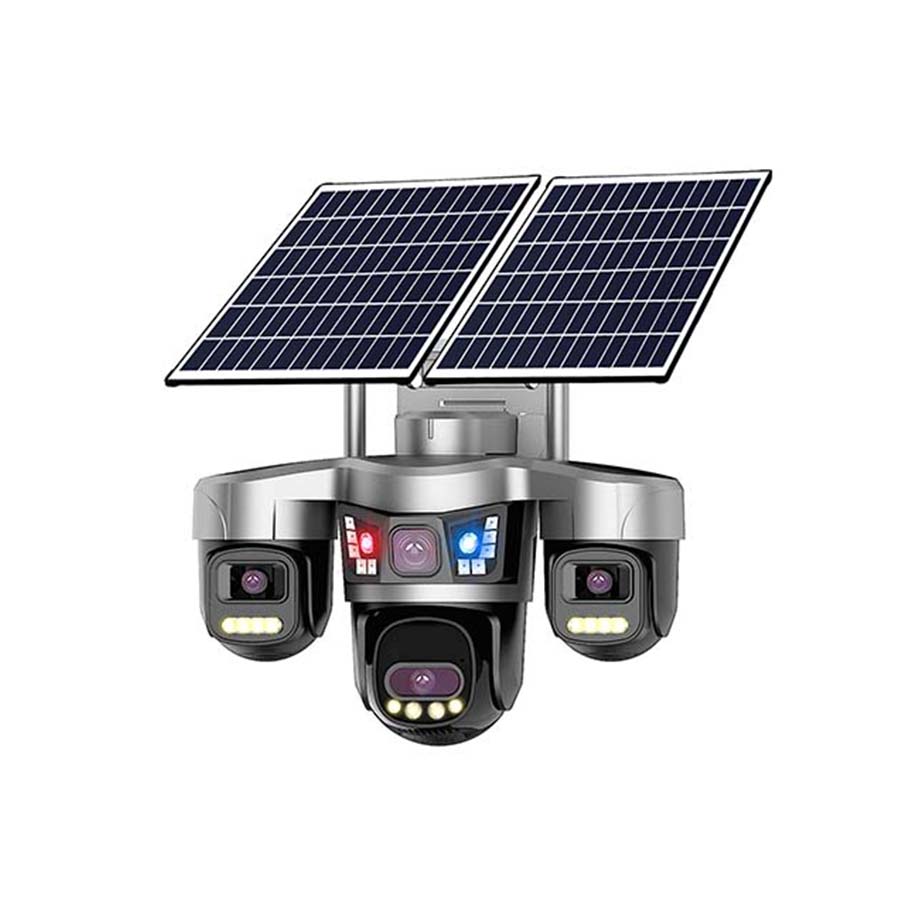
Recommended: MS41 Solar 4-Lens Pro Dual-Panel
Four-lens simultaneous coverage on dual monocrystalline panels — the coverage workhorse for large off-grid compounds.
View MS41 Specs Ask about wholesale pricing →Frequently asked questions
Do multiple lenses mean multiple apps or accounts?
No — all channels appear in one app view, tiled live and in playback. It behaves like one camera with several eyes.
Is the resolution per lens lower than a single-lens camera?
Each channel carries its own sensor (typically 2–4MP per lens in our line). Total system resolution is higher than any single-lens unit — the difference is that it's divided across views instead of pointed one way at a time.
Do all the lenses record simultaneously at night?
Yes — each channel has its own IR illumination and low-light sensor, recording simultaneously. That is exactly the point: no channel ever goes dark because another is busy.
How does multi-lens affect data usage on 4G?
With PIR wake-up and event-based upload, 3–4 lens units stay within a normal 4–6GB/month plan. Continuous multi-channel streaming costs more — pick AOV or PIR-first designs for metered SIMs.
The bottom line
Single-PTZ cameras patrol; multi-lens cameras occupy. For solar deployments where the whole point is wide, unwired coverage, three or four simultaneous eyes on one pole is simply a different product class — and the lens-count math is the fastest way to spec it right.