A farm is the hardest place in the security industry to deploy a camera. There is no grid power at the gate, no WiFi at the barn, no wiring budget for 400 meters of trenching — and yet livestock, fuel, tools and machinery are exactly what thieves target. A 4G solar security camera solves all three problems at once: it powers itself, connects itself, and moves with your site. But not every "solar camera" sold online survives a real farm. Here is the checklist we give every agricultural distributor we work with.
1. Solar panel: size for the worst week, not the best day
The most common failure we see is panel under-sizing. A camera that runs fine in July goes dark in December — or after four rainy days. Three numbers matter:
- Panel wattage: a camera with 4G transmission, IR night vision and PIR wake-ups consumes roughly 3–6W on average. Your panel should harvest at least 3× the daily consumption in winter sun conditions, not summer. For most regions, that means 6W monocrystalline minimum, 10W+ for dual-panel units.
- Monocrystalline vs polycrystalline: monocrystalline panels deliver 20–30% more harvest per square centimeter and perform far better in low light. On a farm, always monocrystalline.
- Fixed vs detachable panel: if the camera must mount under a roof, in a barn doorway or facing away from the sun, choose a model with a detachable external panel that can sit meters away in full sun — such as the MS22 dual-lens solar PTZ or the MS45 with external 4G antennas.
2. Battery: chemistry decides whether it survives winter
Capacity is not the only spec. LiFePO4 (lithium iron phosphate) batteries cost slightly more than ordinary lithium-ion but last 3–4× more charge cycles (2000+ vs 500–800), tolerate heat far better, and do not catch fire when a charge controller fails in a 45°C equipment shed. For a camera that must run 365 days unattended, LiFePO4 is non-negotiable. Look for 20,000–30,000mAh capacity on 4-lens units — enough to ride through 5–7 fully overcast days without any solar input.
3. 4G connectivity: bands matter more than bars
A 4G camera is only as good as its modem. Before ordering any quantity, verify:
- Regional band support. North America (B2/B4/B12), Europe (B1/B3/B7/B20), Africa and the Middle East (B1/B3/B8/B20/B28) and Southeast Asia (B1/B3/B5/B8/B40) all differ. A camera without your market's primary band will fall back to slow 3G or drop offline entirely. We ship region-specific modem configurations as standard — tell us your market and we confirm the band list.
- External antenna option. Metal barn roofs and remote pastures kill internal antennas. Models with external, positionable 4G antennas (like the MS45) routinely double the signal quality at the same SIM plan.
- Data consumption. Expect 2–6GB per month per camera with motion-triggered clips and live-view use. PIR wake-up designs that sleep at 0.5W between events keep this low; always-on streaming designs can burn 30GB.
4. Lens coverage: do the math before choosing the count
The "right" number of lenses depends on what you're watching:
- 2 lenses (wide fixed + PTZ zoom) — one gate, one yard. Compact and affordable; see the MS21 or MS22.
- 3 lenses — gate + yard + feed store covered simultaneously, each with independent PTZ. The sweet spot for most smallholdings: MS31 / MS32.
- 4 lenses + dual panel — large compounds, equipment yards, multiple buildings. Maximum coverage and maximum harvest: MS41 / MS45.
Because each lens has its own image sensor, multi-lens units deliver simultaneous views on one screen — no mechanical patrolling delay between the gate and the barn.
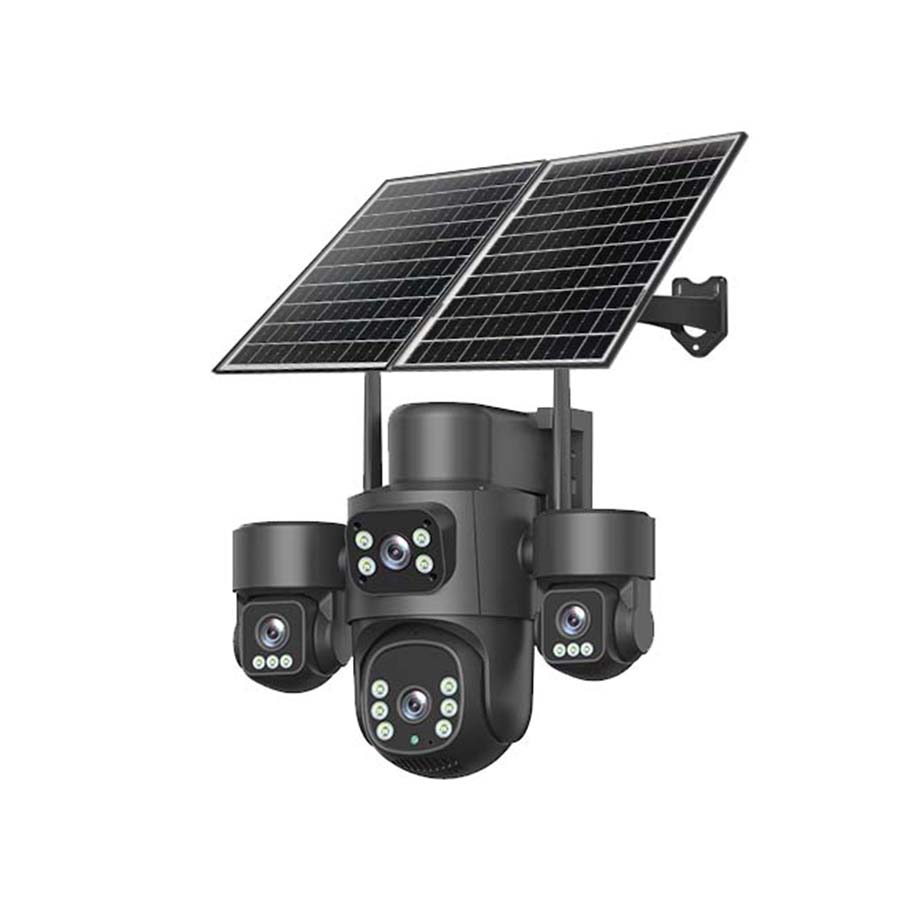
Recommended: MS45 Solar 4-Lens PTZ Pro 4G
Four independent PTZ lenses, dual monocrystalline panels, external positionable 4G antennas — built for the weakest-signal, most remote installations.
View MS45 Specs Ask about wholesale pricing →5. Detection: PIR wake-up beats pixel motion
On a farm, motion alerts used to mean "the wind moved a tree." A proper PIR (passive infrared) sensor detects body heat, so alerts mean a person or animal is actually there — cutting false alarms by 80–90% and battery/data drain with them. The best units combine PIR wake-up with AI human-shape filtering on top, so grazing cattle don't trigger 3 a.m. push notifications either.
6. Build quality: IP66 is the floor, not the target
Dust in harvest season, monsoon rain, −10°C mornings, 50°C tin-roof afternoons. IP66 keeps driving rain and dust out; IP67 adds temporary immersion protection. Check also the operating temperature range in the spec sheet (−10°C to 50°C covers most agricultural climates) and whether the housing is UV-stabilized plastic or metal — cheap ABS yellows and cracks within two summers.
7. Buying checklist
- Monocrystalline panel, 6W+ (10W+ for multi-lens), detachable if mounting in shade
- LiFePO4 battery, 20,000mAh+, stated cloudy-day autonomy of 5+ days
- 4G modem with your market's primary LTE bands confirmed in writing
- External antennas for metal-roof or low-signal sites
- PIR + AI human detection (not just pixel motion)
- IP66/IP67 housing, −10°C to 50°C operating range
- Two-way audio if you need to shout at the gate from your phone
- Local TF card storage (128GB) plus cloud option — farms have no NVR closet
Frequently asked questions
Do 4G solar cameras work in areas with no phone coverage at all?
No — 4G models need cellular coverage. For truly zero-signal sites, options include a long-range WiFi bridge from the farmhouse or a dual-mode 4G/WiFi camera that uses whichever network reaches it. Ask us about hybrid models.
How much does the SIM data plan cost per camera?
Typically $3–8/month depending on country and carrier for a 2–6GB plan with motion-triggered recording. Always-on livestreaming pushes this much higher — choose PIR wake-up designs to keep data low.
Can the camera keep recording at night?
Yes. Black-light (starlight) sensors with 940nm invisible IR deliver full-color footage in near-total darkness without the red-glow giveaway of standard 850nm IR.
What is the typical MOQ for farm-project orders?
Trial orders can start at a few units for site testing. Container projects with custom logo, packaging and firmware defaults are our OEM/ODM specialty — talk to the factory.
The bottom line
A well-specified 4G solar camera runs for years with zero wiring, zero electricity cost and one SIM card. A badly-specified one becomes a December support ticket. Size the panel for the worst week, demand LiFePO4, confirm the 4G bands for your market — and buy from a factory that publishes its cloudy-day autonomy numbers.