A construction site is the most temporary thing you will ever secure. The asset value on the ground is high and constantly moving, the site has no power supply until the project is nearly finished, and the perimeter changes shape every few weeks. That combination is why construction theft is rarely a security-technology problem — it is a deployment-speed problem. This guide covers what actually works when the site has no electricity, no network and no permanent anything.
1. What gets stolen, and when
Site crime is not random. Across the markets our customers work in, three patterns repeat:
- Night removal of materials. Rebar, copper cable, cement, timber and scaffolding fittings leave in vehicles between 11 p.m. and 4 a.m. These are the losses that turn a profitable project into a thin one.
- Fuel and plant. Diesel tanks, generators and small plant are targeted precisely because they are mobile and easy to resell. A single generator loss can exceed the cost of securing the site for the whole project.
- Insider and weekend losses. Smaller tools and consumables disappear at shift changes or over weekends — a pattern that only continuous visibility catches, because there is no forced entry to investigate.
The common thread is timing: all three happen when nobody is present. Which is exactly the window a conventional wired camera — with its power and network dependencies — is least likely to be watching.
2. Why the site has to be wireless and solar
- No power before handover. On most projects the permanent supply arrives at the end of the build, not the start. Solar removes the need to negotiate a temporary supply, run cable across a site being excavated, or rely on a generator that itself is a theft target.
- The perimeter moves. A camera tied to a fixed conduit cannot follow a fence line as the works advance. Solar units mount on a pole, a container corner or a wall, and relocate in minutes.
- No network to join. Sites have no WiFi, and trenching for network cable across an active construction zone is neither safe nor cheap. Built-in 4G carries the footage out from day one.
- Deployment speed. Because there is no cable, one person with a drill-mounted pole can have a unit recording within minutes — which means security can be in place on the night the first materials arrive, not a week later.
3. Match the configuration to the phase of the project
| Project phase | What is at risk | Suggested configuration |
|---|---|---|
| Site clearance and earthworks | Plant, fuel, site office container | 4-lens unit for wide compound coverage — MS41 class |
| Structure and cladding | Rebar, steel, fixings, cable reels | 3-lens unit aimed at storage stacks — MS33 class |
| MEP and fit-out | Copper cable, tools, small plant | 2–3 lens units on internal access points — MS32 class |
| Perimeter and gate house | Everything, at the only real choke point | 4-lens dual-panel with external antenna — MS45 class |
Note the difference from a permanent installation: on a site under construction, the camera's job is to be pointed at the material, not the building. Deploy where the value is stored this week, and move it when the value moves.
4. Deterrence is the point, not the recording
Recovering stolen materials through footage is rare. Preventing the removal is the objective, and it happens in the first thirty seconds of an attempt:
- 110 dB siren and strobe light. A sudden siren and a flashing light on a dark site changes the intruder's calculation immediately. Most attempts end at that moment, not at the fence.
- Two-way audio. A voice telling a person they are on camera and that the site manager has been alerted is more effective than any number of recorded frames.
- PIR plus human-shape filtering. Sites are full of movement — plastic sheeting, birds, passing traffic, materials shifting in wind. AI filtering that distinguishes a human shape from everything else is what keeps notifications meaningful.
- Spotlight and full-colour night footage. Colour detail in clothing and vehicle livery is what makes a report actionable for police and insurers.
5. Coverage layout for a fenced site
A site does not need cameras along the whole fence. It needs them where the fence is a route rather than a barrier:
- The gate or the one access road — the only place a vehicle must slow down and pass. Cover both directions of approach.
- Storage stacks and the consumables compounds — pointed down at the material, angled to catch faces rather than the top of helmets.
- The diesel tank and generator compound — the single highest-value overnight target on most sites.
- Blind corners and the rear boundary — the natural entry route away from the floodlit gate area.
- The site office container where tools, tablets and documents are kept.
Height and angle follow the same rule as anywhere else: 3–4 m, tilted down 10–15 degrees. A camera aimed at the horizon records sky all night and identifies nobody.
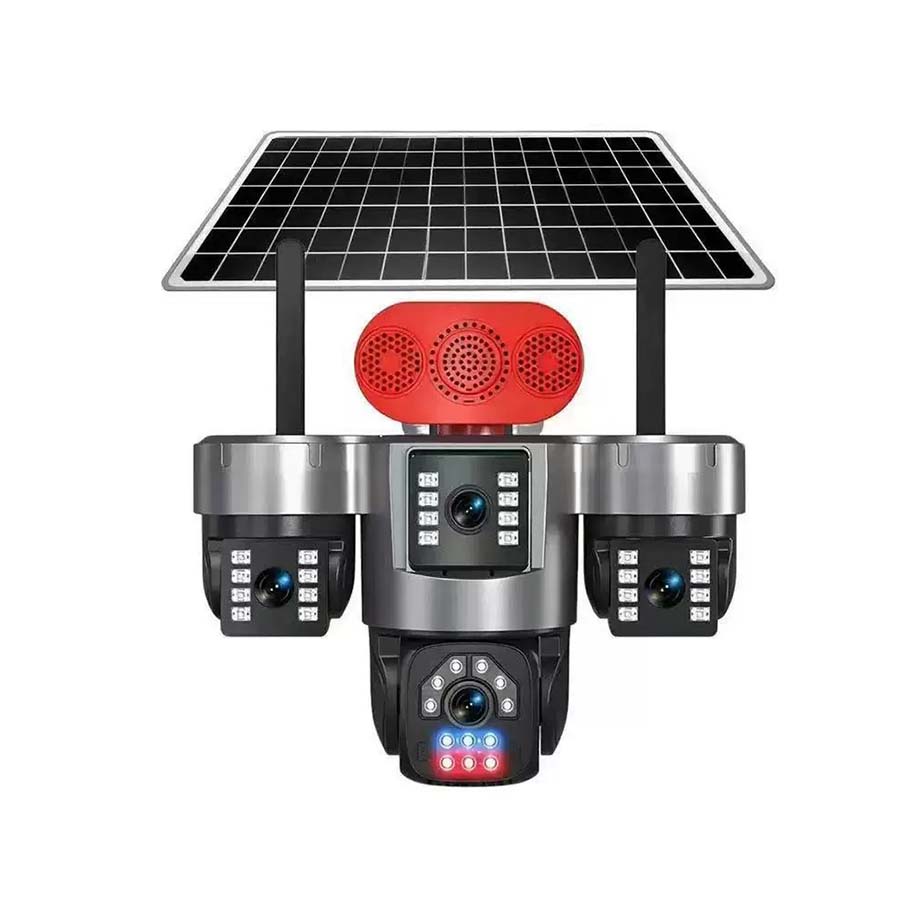
Site standard: MS33 3-Lens Solar Camera with 110 dB Siren
Three simultaneous lenses to cover the gate, the material stack and the plant compound in one unit — with the siren and strobe that interrupt an attempt rather than merely recording it.
View MS33 Specs Request a sample unit →6. Footage that stands up to a claim
Construction losses are mostly insurance and contract matters, and that changes what "good footage" means. Timestamped colour video that shows the material, the individuals and the vehicle is what closes a claim or settles a subcontractor dispute — and it needs to survive the incident, not just record it.
- Local TF card recording means footage survives even if the cellular link drops or the SIM runs out of data mid-project.
- On-demand live view lets a project manager check the site at 2 a.m. from a hotel room without streaming all night and burning the data allowance.
- Playback by timeline makes the review of a specific eight-hour window practical rather than a hunt through recordings.
- Multi-user access lets the security contractor, the site manager and the client's quantity surveyor each hold their own view of the same units.
7. Relocating units as the works advance
A site camera has a working life of a few months in one position. Plan the moves in advance so security never has a gap:
- Mount on removable poles or container brackets from the beginning — the same pole should be reusable in at least three positions over the project.
- Keep the SIM and app configuration unchanged when relocating, so the unit rejoins the same account and history after the move.
- Re-survey the signal at each new position. On a site with cranes, steel frames and excavations, the 4G level at the new pole is not the level at the old one. Where coverage is weak, external-antenna models such as the MS45 hold the link that an internal antenna loses.
- Redeploy to the next project at handover. Sites that buy rather than rent recover the units across multiple projects — which is usually the cheaper route for contractors with a steady pipeline.
The bottom line
Securing a construction site is not about installing a permanent system on temporary ground. It is about putting self-sufficient units exactly where the value is stored this month, with a siren loud enough to end an attempt and footage clear enough to support a claim — and moving them when the project moves. Solar and 4G are not a workaround here. They are the reason the unit can be deployed on the night the materials arrive.
Frequently asked questions
Can security cameras work on a construction site with no electricity?
Yes. Solar cameras carry their own panel and battery, so no temporary supply is needed. On an active site this is an advantage beyond convenience: there is no cable to trench across an excavation, no generator to fuel, and no temporary connection to negotiate before security can be deployed.
How quickly can a site be covered?
A single solar 4G unit mounts on a pole, container corner or wall and starts recording within minutes, because there is no power or network cable to run. A typical site gate plus material store layout is covered the same day the units arrive, which means security is in place before the first high-value delivery rather than a week after it.
Do construction site cameras need WiFi?
No. These units use their own 4G connection, which matters because sites have no WiFi network to join. What you do need to confirm before ordering is the LTE band coverage of the local carriers at the site, since signal strength at a gate house can differ significantly from the rear boundary.
Is recorded footage useful for insurance claims?
It is, provided the footage is timestamped, in colour and shows the material together with the individuals and vehicle involved. Local TF card recording keeps that evidence even if the cellular link drops, and the ability to replay and export a specific time window is what makes a claim straightforward to support.
Can the same cameras be reused on the next project?
Yes, and most contractors do exactly that. Mount units on removable poles or container brackets so they can be repositioned as the works advance, then redeploy them at handover. Over several projects this works out considerably cheaper than renting temporary site security.