Perimeter security fails for a reason that has nothing to do with camera quality: a perimeter is a line, and coverage is usually bought as a set of points. The result is a site with excellent footage of its front gate and no idea that someone walked in through the third acre of fence at 2 a.m. This guide covers the three things that actually determine whether a boundary stays secure — the layering of detection and verification, the real ranges at which a camera can identify rather than merely see, and the false-alarm discipline without which no perimeter system survives past its first month.
1. Four layers, and what belongs in each
A perimeter is not one technology. It is a chain, and it is only as strong as the weakest link in it:
| Layer | Function | Typical technologies |
|---|---|---|
| 1. Deter | Make the site look harder than the next one | Visible cameras, lighting, signage, siren and strobe |
| 2. Detect | Know that something crossed the line, and where | Infrared beams, fence-mounted vibration sensors, buried cable, electric fence, PIR |
| 3. Verify | See what it actually was, and whether it needs a response | Cameras — this is the layer that turns an alert into a decision |
| 4. Respond | Do something about it | Siren, two-way audio, patrol dispatch, police report |
Two conclusions follow. First, cameras are the verification layer, and without detection in front of them they are only useful after the fact. Second, a single detection technology will always have either a high false-alarm rate or a real gap — which is why the sensible perimeter is cheap detection plus good verification, not one very expensive sensor line.
2. Detection, recognition, identification — and why one number is misleading
Specifications that quote a single range figure are quoting the flattering one. The three ranges differ substantially, and only the shortest one is evidence:
- Detection. The camera sees that there is something in the frame. Useful for alerting, and for knowing the direction of approach.
- Recognition. You can tell a person from an animal, and see what they are carrying or doing. Useful for deciding whether to respond.
- Identification. You can distinguish a face, clothing and vehicle detail. This is the only range that supports an insurance claim, a police report or a dismissal.
Two consequences for perimeter design. First, the value of any camera is set by its identification range at night, not its detection range at noon. Second, where the boundary is long, you do not need identification everywhere — you need it at the crossing points, and detection everywhere else. For the long-distance work itself, an optical-zoom PTZ such as the MS43 or the dual-antenna MS45 identifies at distances a fixed wide lens cannot reach.
3. False alarms are the design flaw that kills perimeter systems
Outdoor boundaries are full of movement that is not intrusion: wind-driven vegetation, animals, plastic sheeting, passing traffic beyond the fence, rain, and shadow patterns that move with the sun. A system that alerts on all of it gets muted within a week, and a muted system provides no security whatever — it merely has a maintenance cost.
- PIR plus human-shape filtering. The essential combination. PIR establishes that something with a heat signature moved; the AI shape filter establishes that it resembles a person rather than a cat or a swaying branch. Alert quality, not camera specification, is what determines whether anybody still reads them in month three.
- Detection zones with deliberate exclusions. Mask the public footpath, the road beyond the fence and any tree canopy. Excluding known-good movement is not a compromise on security, it is what preserves the credibility of alerts.
- Scheduled sensitivity. Working hours, deliveries and shift changes legitimately generate movement around gates. A zone that is permissive at 3 p.m. and strict at 3 a.m. produces far more useful alerts than any single setting.
- Measure the result, not the alarm count. Track how many alerts per week required action. If the ratio is under one in ten, the configuration is wrong, whatever the datasheet says.
4. Where to place cameras on a boundary
A perimeter does not need cameras along its entire length. It needs them where the boundary is a route rather than a barrier — and there are six positions that carry most of the value:
- Gates, barriers and vehicle entrances. The only place a vehicle must slow down; cover both approach directions.
- Corners. The point where an intruder is briefly visible in two directions at once, and the natural place to climb.
- Where the fence meets a building. The classic gap — roof lines, downpipes and service doors create unwatched corners that have been used in every documented perimeter intrusion.
- Low sections, embankments and drain crossings. Anywhere the boundary changes character, including places where a vehicle can be brought close on the outside.
- The rear boundary and the unlit side. Almost always the real approach route, because it is the one furthest from the lit, watched frontage.
- The highest available point for the long stretches. One elevated unit overlooking three hundred metres of fence line is worth more than several units at eye level near the ground.
And the counter-rule: do not put a camera where it can only see the far side of the fence. Footage of someone walking past on public land is not evidence of anything, and it produces the alerts that get the whole system muted.
5. Lighting, deterrence and the response chain
- Light the crossing points, not the entire boundary. Illuminating the gate, the yard and the rear approach is achievable and effective; floodlighting a kilometre of fence is neither affordable nor considerate to neighbours.
- Siren and strobe at the boundary. The purpose is to interrupt the attempt in the first thirty seconds, and the perimeter is where that intervention is most effective — the intruder is still outside the assets they came for.
- Two-way audio turns an alert into a conversation. A voice stating that the site is monitored and that the operator can see them changes behaviour immediately.
- For tracks, fence lines and outer boundaries where illumination is needed anyway, a street-light camera such as the MSL31 delivers both from one pole — one foundation instead of two, and no separate lighting circuit to build and maintain.
- Decide the response before you install. A camera that nobody can act on at 3 a.m. is a recording device, not a security system. Whether the answer is a patrol, a neighbour, a monitoring station or a siren that acts on its own, the response route belongs in the design.
6. Long boundaries: why self-powered units change the cost model
On a boundary of five hundred metres or more, the cost of a conventional installation is dominated not by cameras but by getting power and data to them. Trenching through a yard, crossing a road, running a circuit along a fence line — each position is a separate civil and electrical job, and the cable itself becomes a point of failure that is exposed to weather and to being cut.
- Deploy at the position that is correct, not at the nearest place where a supply happens to exist. Coverage should be decided by geometry, not by where the nearest conduit ends.
- Move the boundary when the site changes. Fence lines are extended, re-routed and replaced. A self-powered unit relocates in minutes instead of being re-trenched.
- Reduce the failure surface. No long copper runs means no lightning-induced damage, no connector corrosion and no third-party cuts. A fault is one unit, not a whole segment of the perimeter.
- Extend in stages. Add positions one at a time as budget allows, without re-doing any civil works and without waiting for a trenching contract.
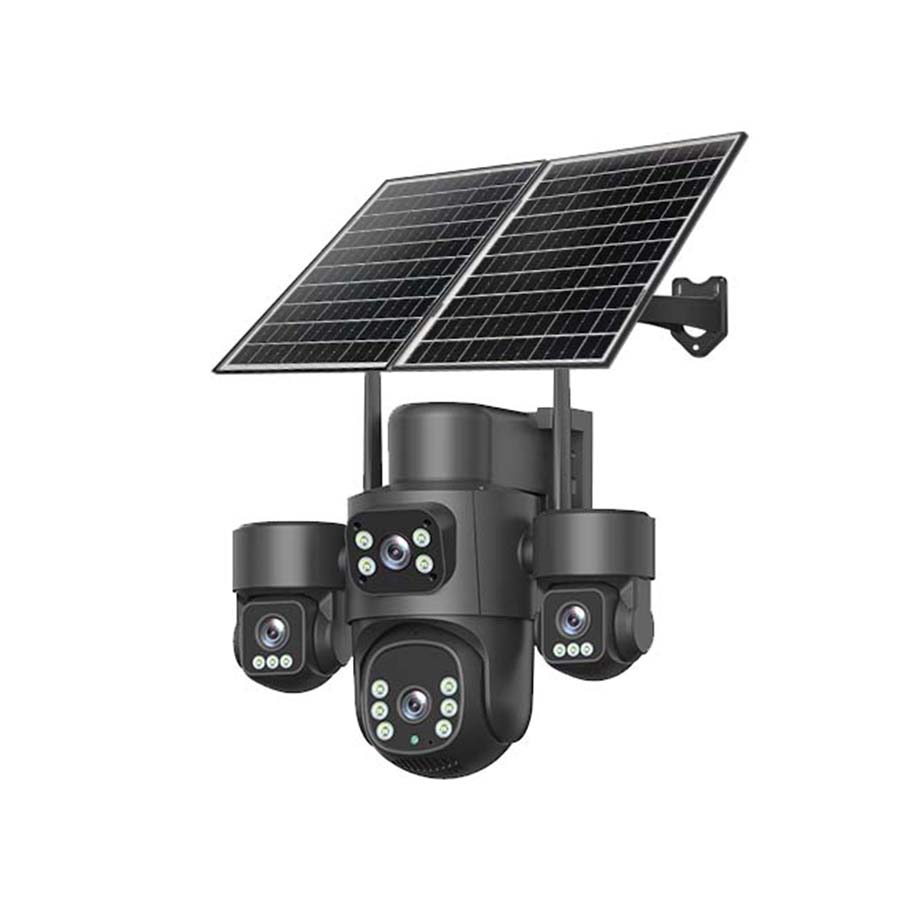
Boundary workhorse: MS45 4-Lens Solar PTZ with External Antennas
Four simultaneous lenses plus 360° PTZ coverage, dual panels and external 4G antennas that hold the link where an internal antenna drops it — built for long fence lines far from any infrastructure.
View MS45 Specs Plan a perimeter layout →7. Specifying a perimeter in six questions
- What is the total boundary length, and which parts are a route rather than a barrier? This sets the sensor run and the number of camera positions.
- Where does the boundary change character? Corners, gates, drain crossings, fence-to-building junctions and low sections.
- What detection exists already? If there is none, plan the cheapest workable sensor line and let the cameras verify it — do not attempt to make cameras the detection layer.
- What identification distance do you need at night? Asked of the supplier in writing, and answered for colour night footage rather than for daytime detection.
- What is the response route at 3 a.m.? Determines whether you need a siren, a monitoring contract, a patrol or all three.
- How much power and data infrastructure exists at each intended position? On most long boundaries the answer is none, which is where the self-powered approach stops being a shortcut and starts being the only cost-effective option.
The bottom line
A secure perimeter is not the one with the most cameras on it. It is the one where every crossing point is lit, every alert means something, and the identification range at night actually reaches the place a person would have to stand to get in. Get the layering right and the boundary does the work. Get it wrong and you own a very large quantity of footage of the outside of your fence.
Frequently asked questions
How many cameras does a perimeter need?
Far fewer than boundary length alone would suggest. Cameras belong at the places where a boundary is a route rather than a barrier: gates, corners, fence-to-building junctions, low sections, drain crossings and the rear or unlit side. Long straight runs are better covered by one elevated unit with optical zoom plus a low-cost detection line than by evenly spaced cameras along the whole fence.
What is the difference between detection range and identification range?
Detection range is the distance at which a camera can see that something is present. Identification range — the distance at which a face, clothing or vehicle detail is distinguishable — is much shorter, particularly in colour at night. Only the identification range supports a police report or an insurance claim, so it is the figure to specify rather than the headline detection number.
Why do perimeter camera systems get ignored after a few weeks?
Because of false alarms. Wind-blown vegetation, animals, passing traffic beyond the fence and shifting shadows all trigger naive motion detection, and once an alert stream is muted the system provides no security at all. PIR combined with human-shape filtering, detection zones with public areas excluded, and different sensitivity by time of day are what keep the alert stream worth reading.
Do perimeter cameras need mains power along the fence?
Not with self-powered units. Each carries its own solar panel, battery and 4G modem, so a camera can be placed where the coverage geometry requires rather than where a conduit happens to end — which on boundaries of several hundred metres normally removes both the trenching and the electrical works from the budget.
Can solar cameras keep a perimeter online through bad weather?
The battery, not the panel, is what carries the system through overcast periods. With a LiFePO4 pack and PIR-triggered recording, a properly sized unit typically runs several days with no meaningful sunlight. Continuous recording is what destroys that autonomy, which is why PIR wake-up recording is the correct default for perimeter and remote installations.