Nigeria is one of the most natural security-camera markets on earth — and one of the hardest on the equipment. Grid power arrives in surges and gaps, wired CCTV on a long fence means diesel-generator dependency, and theft pressure makes "record it and check later" inadequate. This is exactly the environment solar 4G cameras with active deterrence were built for. We ship into West Africa weekly; here is what our export team tells every Nigerian installer, security shop and importer before they order.
Why solar + 4G fits Nigeria better than anywhere
- Grid reality is the sales pitch. A camera that carries its own power supply never blinks when the transformer does. "Works through every blackout" closes deals in Lagos the way "4K resolution" never will.
- Wiring is theft-prone. Copper cable runs between buildings get harvested. A solar camera on a pole has no cable to steal.
- 4G coverage is broad and cheap. MTN, Airtel, Glo and 9mobile cover urban and most peri-urban areas, and data bundles are affordable. A camera with the right bands turns any of those SIMs into a live feed.
- Sunlight is the one resource Nigeria never lacks. A monocrystalline panel in Lagos or Kano out-harvests the same panel in Europe by 30–50%.
Check #1: the 4G bands on the actual modem
This is the single most common failure we fix. Nigerian LTE networks run primarily on:
| Band | Frequency | Typical use in Nigeria |
|---|---|---|
| B1 | 2100 MHz | MTN / Airtel LTE |
| B3 | 1800 MHz | Primary capacity band on all major carriers |
| B7 | 2600 MHz | Urban capacity (Lagos, Abuja) |
| B8 | 900 MHz | Coverage/rural reach |
| B20 | 800 MHz | Coverage layer |
| B28 | 700 MHz | Newer coverage deployments |
| B40/B41 | 2300/2500 MHz TDD | Fixed-wireless and some data carriers |
A modem that only carries European band sets will limp on B3 alone or drop to 3G. Before ordering, ask the factory for the written band list of the modem inside the camera — and test one unit with a local MTN/Airtel/Glo SIM before the container lands. We ship region-configured modems as standard and will send the band list in writing with every quote.
Check #2: battery and panel sized for harmattan and rain
Two West African weather events test a solar camera: harmattan dust (November–March haze cuts panel harvest) and wet-season overcast stretches. What survives both:
- Monocrystalline panels (better low-light harvest) sized 6W+, dual panels on 3–4 lens units
- LiFePO4 batteries — 45°C storage-shed heat and daily deep cycling destroy ordinary lithium packs in under two years; LiFePO4 lasts 4–5
- Stated cloudy-day autonomy of 5+ days — ask the supplier for the number, in writing
Check #3: deterrence, not just recording
West African buyers consistently prefer cameras that stop incidents, not just archive them. That is why siren and strobe models dominate repeat orders:
- MS33 — 3 lenses + 110dB siren + red strobe: the loudest deterrent in the solar line
- MS42 — 4 lenses + siren + dual panels for larger compounds
- MS21 — red/blue strobe + PIR on a compact 2-lens body: the volume model for gates and shops
When the floodlight snaps on and the siren sounds at 2 a.m., the intruder leaves — and your customer becomes a referral machine.
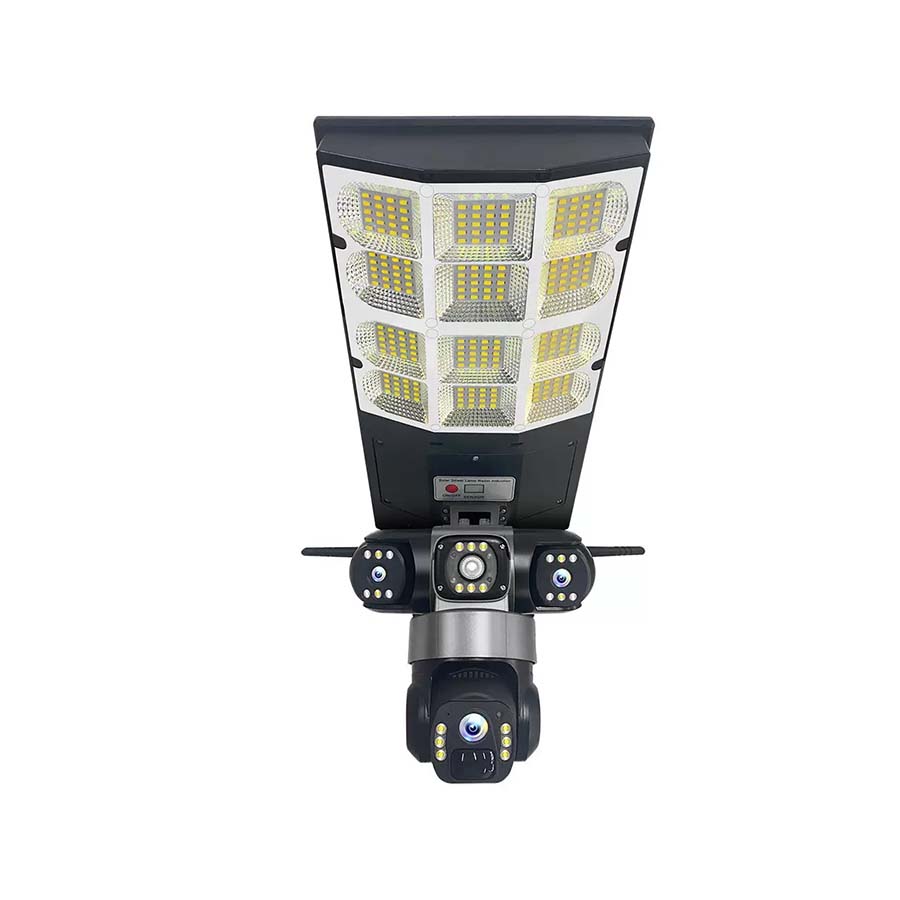
Best-seller: MSL31 Solar Street Light + 3-Lens PTZ
Street light and security camera on one pole — dusk-to-dawn illumination plus full PTZ monitoring. One install, two problems solved. Extremely popular for estates, gates and shopfronts.
View MSL31 Specs Ask about wholesale pricing →Check #4: installation practice for high-theft areas
- Mount at 3.5–4.5m — above ladder-reach, below the angle where details vanish.
- Anti-theft mounting: use security screws; site the camera where its own siren covers its own pole.
- Panel angle: in Nigeria, tilt the panel roughly 5–15° from horizontal, facing south (or north in the far north of Ghana/Niger trade areas) — near-equatorial sun means a nearly flat panel is optimal and catches less wind.
- Clean the panel at harmattan's end. A dust film can cut harvest by 20–40%; a 10-second wipe is the whole maintenance schedule.
Check #5: import math for shops and installers
- Order region-configured stock — confirm bands + pre-loaded app (iCSee-compatible) before paying the deposit.
- Mixed-model containers move fastest: a practical first container is 40% volume models (MS21/MS31), 30% deterrence models (MS33/MS42), 20% street-light cams (MSL31), 10% indoor (MI11/MI21) for shop-counter upsells.
- Demo units sell the container: one working camera at your counter closes more sales than any brochure. Budget two demo units per shop.
- OEM is realistic at modest volumes: your logo on the housing and box, firmware defaults to your support number — from trial orders upward, talk to us.
Frequently asked questions
What do solar CCTV cameras cost in Nigeria?
Retail prices vary widely by lens count and battery size. As a factory reference: dual-lens solar units wholesale in the $25–45 range, 3-lens $40–60, 4-lens dual-panel $55–90 — Nigerian retail typically marks up 60–100%. Ask us for the current FOB price list.
Which SIM works best in a 4G solar camera?
Any of the major carriers (MTN, Airtel, Glo, 9mobile) with a data plan of 3–6GB/month per camera. Test one SIM from each carrier at the actual install site — coverage varies street by street.
Will the camera survive 45°C heat?
Our housings are rated −10°C to 50°C operating, and LiFePO4 chemistry handles high temperatures far better than standard lithium. Avoid mounting where the afternoon sun heats the housing itself — shade the body, sun the panel.
What is the MOQ to start importing?
Trial orders from as low as 20–50 mixed units are possible to test your market; OEM branding starts at container-scale volumes. Contact the factory with your target quantity for exact terms.
The bottom line
Nigeria's power gaps are a solar camera's home advantage — provided the modem carries the right bands, the battery is LiFePO4, and the product deters rather than just records. Verify those three things with the factory in writing, test one unit on local SIMs, and the container that follows will not be your last.